01
The reasoning layer
Before any sourcing: market map, search strategy, compensation map, seniority logic. TI thinks like a headhunter first, then sources against that strategy.
Claude alone jumps straight to searching.
THE JUDGMENT LAYER FOR HIRING
Every sourcing tool floods you with more candidates, faster. Talent Intelligence does the opposite: fewer names, every one you can defend, and a layer that learns your eye. The more you judge, the more it judges like you.
The honest question isn't what TI does — it's what makes it TI and not just Claude. So let's clear out what is not the differentiator first.
Not the differentiator
It's Claude — the same Claude anyone can call. Claiming a smarter model would be a lie.
It's Claude's chat. Identical to what you already use.
Everyone does. That's table stakes, not an argument.
The layer — what sits between the conversation and the result
Before any sourcing: market map, search strategy, compensation map, seniority logic. TI thinks like a headhunter first, then sources against that strategy.
Claude alone jumps straight to searching.
Real access to where candidates actually are — GitHub at depth, HN, niche communities, multiple providers.
Claude alone gets blocked and rate-limited.
Every profile pulled, normalised and scored against encoded rules: seniority casting, must-have filtering, excluding the over-qualified.
Claude alone lists; it doesn't calibrate.
A recruiter validates every shortlist before it reaches you.
Claude alone hands you unchecked output.
Every candidate evaluation feeds back. The engine sharpens on your roles, your hires, your standards.
Claude alone remembers nothing.
Anyone can wire up an API and a scoring prompt in a weekend. What can't be copied is the judgment inside the layer: which candidates to exclude, why a 39K "Director" is the wrong read, why a brilliant investment-banking director is off-target for a school. Twenty years of casting judgment, encoded and compounding.
One concrete case
A candidate scored 88/100. The casting logic flagged the mismatch, a recruiter confirmed it, and he never made the shortlist. That gap — between a list and a shortlist — is TI.
The big databases bet on volume: you dig, filter, guess. Talent Intelligence bets on precision: the system sources, a recruiter validates, and the engine learns from every hire.
| Sourcing databases | LinkedIn Recruiter | Generic AI assistants | Talent Intelligence | |
|---|---|---|---|---|
| What you get | Sourcing databasesA giant search engine | LinkedIn RecruiterA network and filters | Generic AI assistantsChatbot answers | Talent IntelligenceA delivered shortlist |
| Who does the sorting | Sourcing databasesYou | LinkedIn RecruiterYou | Generic AI assistantsYou check everything | Talent IntelligenceThe system, then a recruiter |
| The "why this candidate" | Sourcing databasesYou guess | LinkedIn RecruiterAbsent | Generic AI assistantsGeneric | Talent IntelligenceExplained and sourced |
| Improves with your hires | Sourcing databasesNo | LinkedIn RecruiterNo | Generic AI assistantsNo | Talent IntelligenceYes — it learns from outcomes |
Nobody's short on volume. What's missing is the right filter — and the memory of what worked.
Not a form to fill in. Talent Intelligence analyses the market, then asks its questions one at a time — with answer options calibrated to the role. You decide: your judgment frames the search.
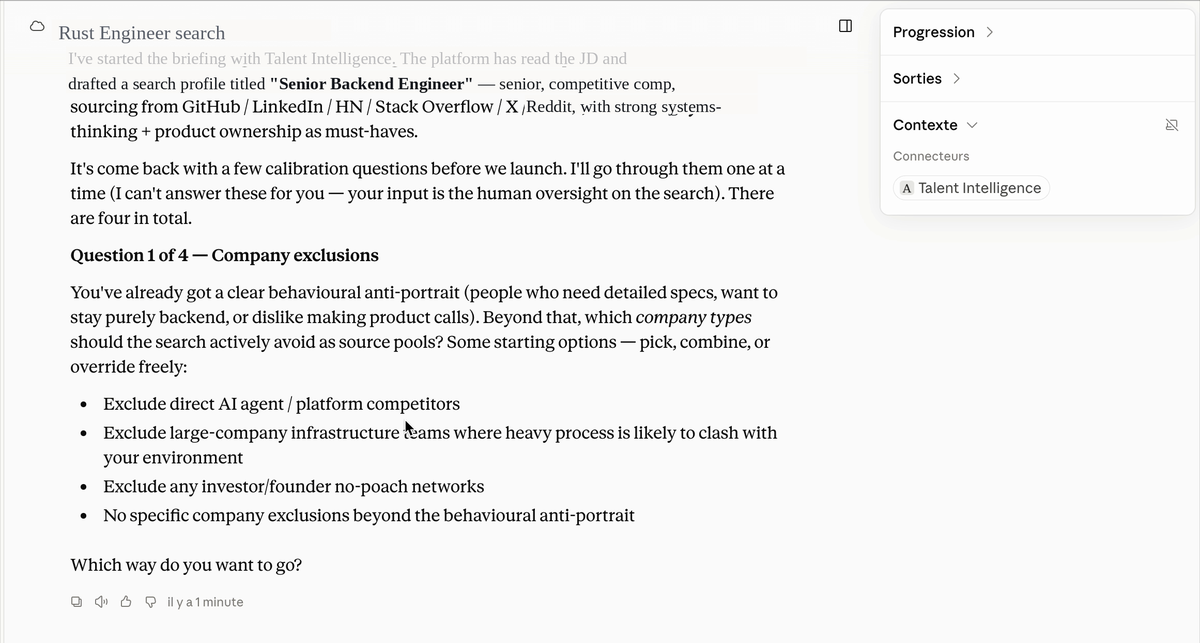
◆ The market read before the questions
◆ Calibration options, never a blank form
◆ Your call frames the search
Then it returns an explained shortlist — scored, sourced, and sorted into strong fits, potential fits, and weak fits.
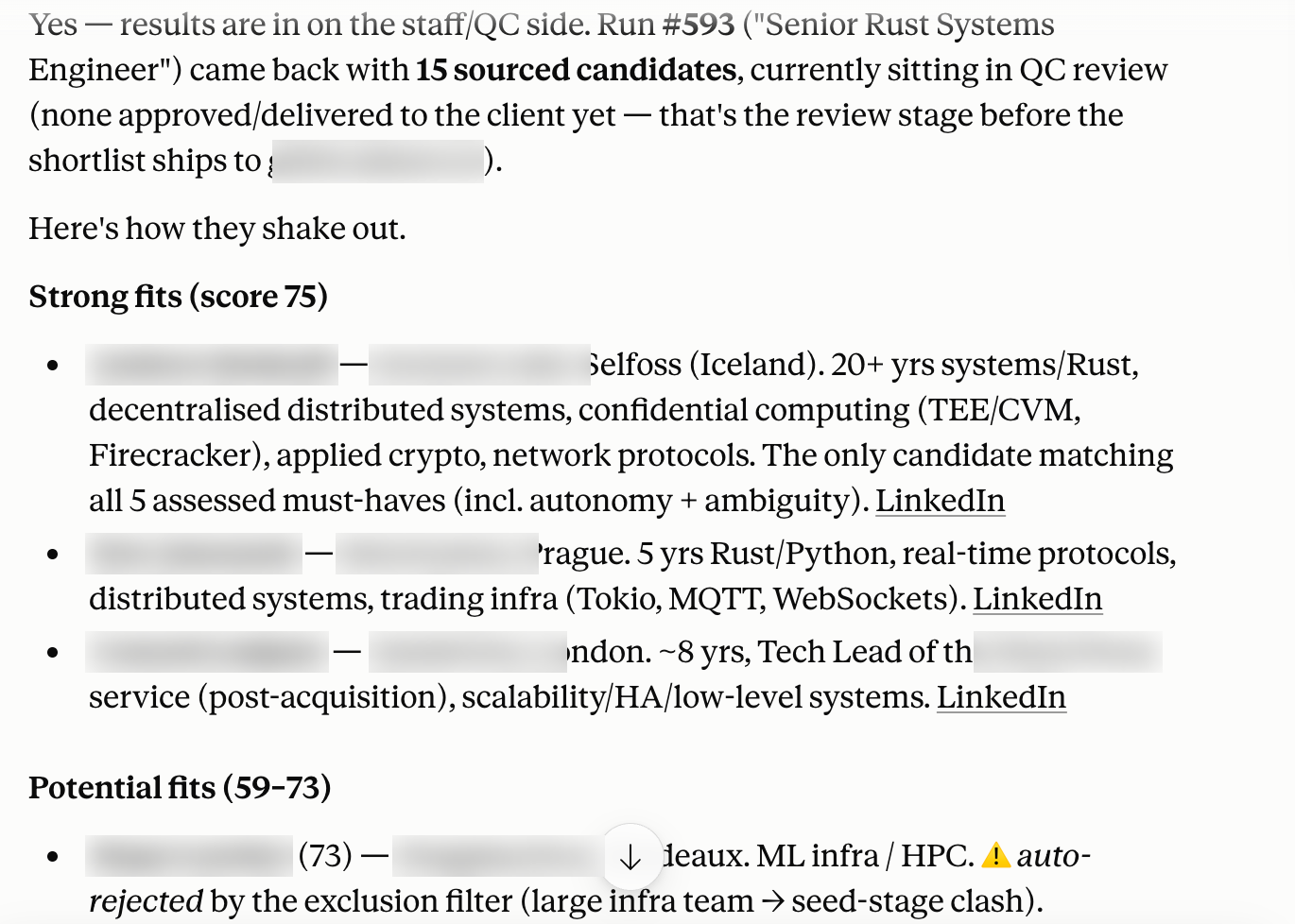
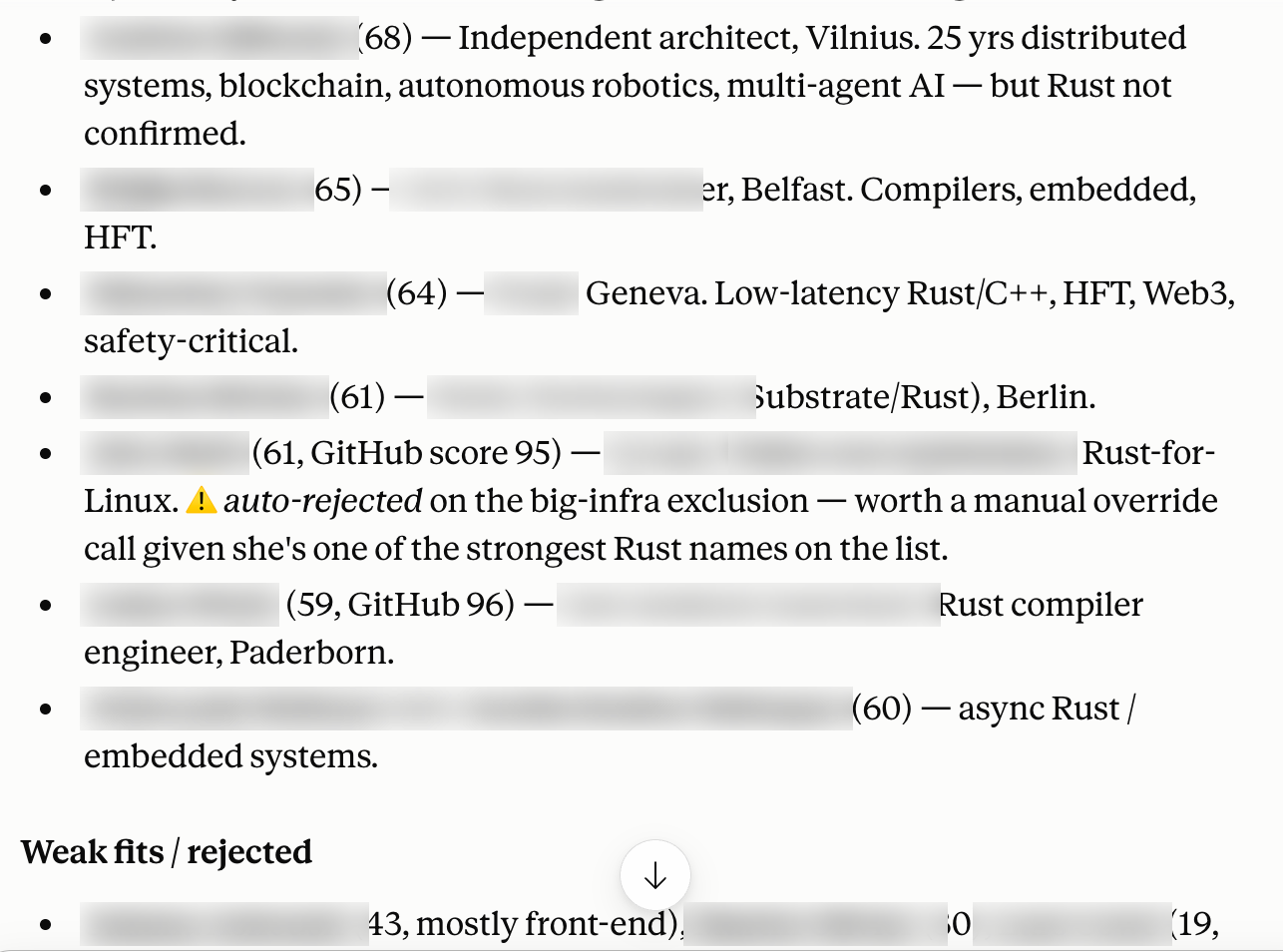
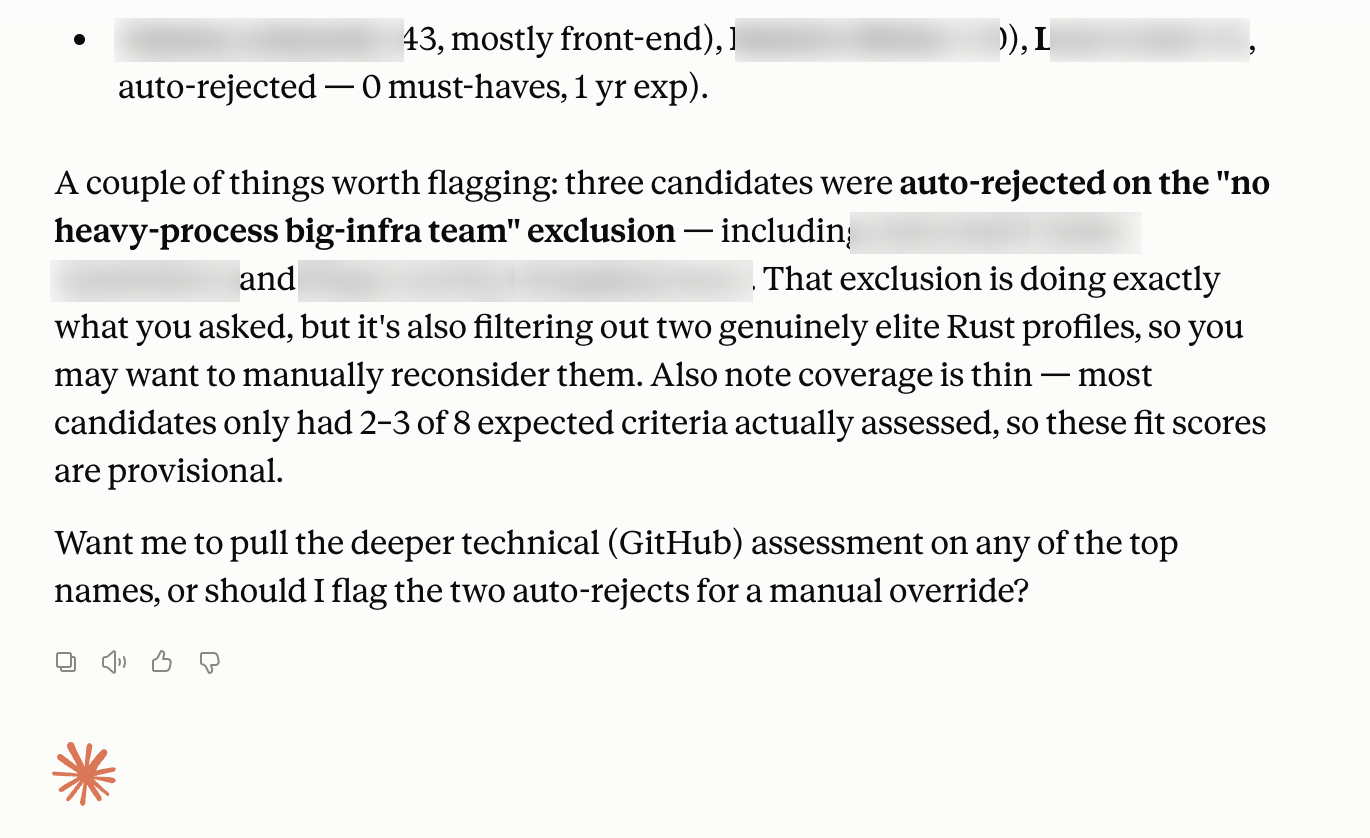
And your ATS answers in the same conversation. Talent Intelligence queries Jarvi, Ashby and others natively inside Claude, so every profile is cross-checked against your pipeline before you approach it.
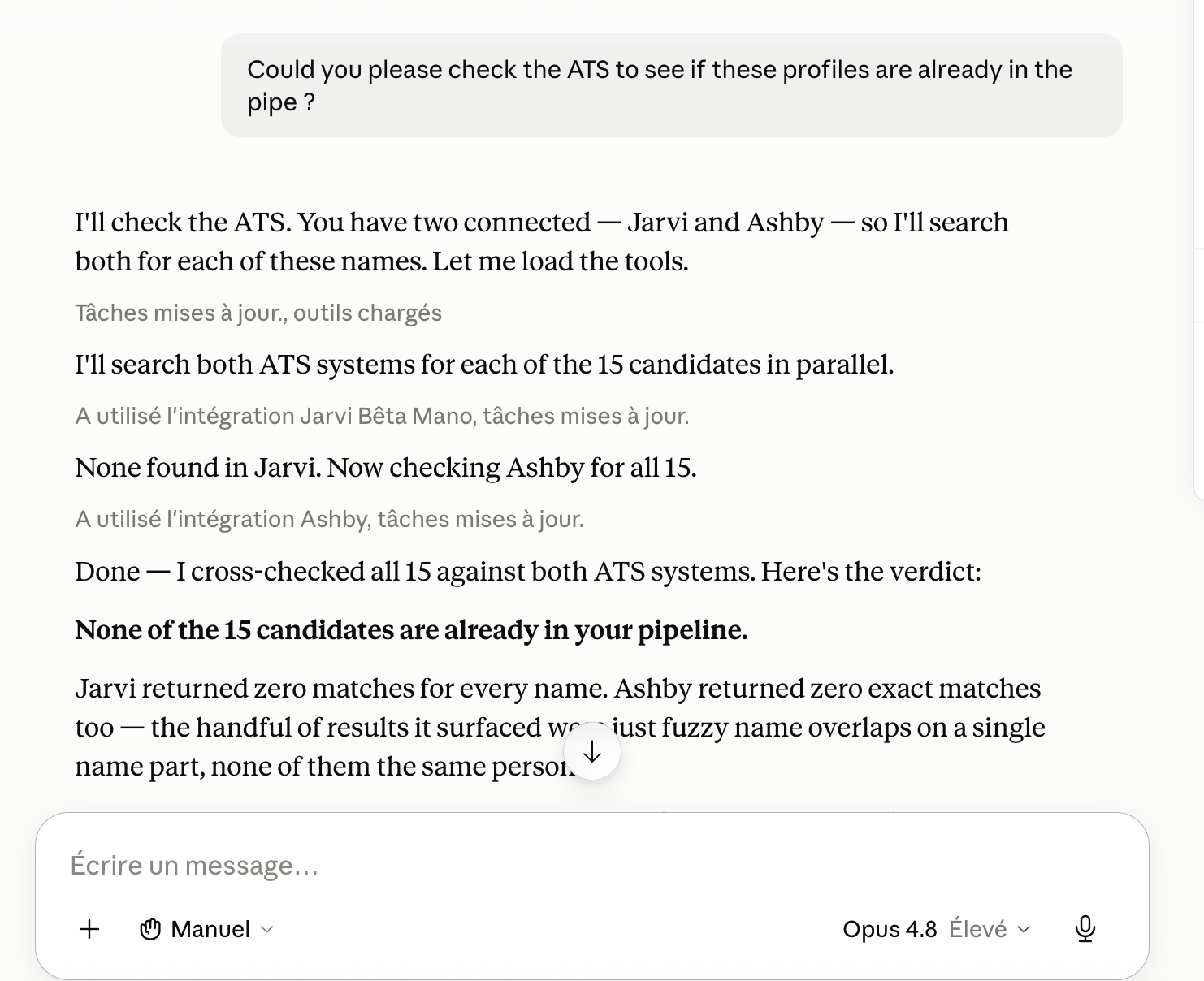
Talent Intelligence doesn't replace your stack — it plugs into it. You connect your ATS to Claude, TI sources candidates there, and it all happens in one conversation: source, qualify, push to your ATS.
You describe the role in conversation. TI and your ATS are connected there as tools.
Sources, enriches, scores. A recruiter validates. An explained shortlist.
Selected candidates go to your ATS, in the same conversation. No re-entry.
You connect your ATS to Claude through its own connector. TI isn't one more system to adopt — it's a building block that joins yours. Interoperable, not proprietary.
Most tools hand you a search engine and leave you to sort. Talent Intelligence delivers a shortlist that's ready to reach out to.
The candidates LinkedIn and job boards don't surface — sourced where they're actually active.
For every candidate, why they fit the role — argued and sourced. Not an opaque score.
Describe the role, go do something else, the shortlist lands. Manual sourcing took days.
In conversation, not a form. You talk through the need, the system grasps the context.
Multi-source search beyond LinkedIn, then enrichment and scoring of each profile.
The strongest profiles, each with its fit argued — strengths, caveats, evidence.
A recruiter reviews every delivery before it reaches you. The decision stays human.
Every candidate evaluation by the company sharpens the engine. It's proprietary data that deepens over time — not a prompt anyone can copy.
Pick a slot that works for you. We'll run a live search for one of your open roles and show you how the shortlist lands inside Claude.
Invite-only · Human oversight on every delivery